

Teaching Shouldn't Be This Hard
We need a 'Simple View of Teaching'

I recently stumbled upon this video from Christopher Mukibi, classroom behavior consultant and teacher. In it, he shares how nervous system depletion occurs in the classroom because “constant emotional processing is more cognitively expensive than actual instruction.”
His argument goes beyond the ethical or moral argument as to why we need to prioritize teacher sustainability. It reiterates the logical argument for teacher sustainability—grounding it in the neuroscience of teaching.
“Our brains are doing the work of an air traffic controller,” he states, “while everyone thinks we are just ‘going over chapter four’ and baby sitting.”
In Make Teaching Sustainable, I share a similar sentiment—that the emotional, spiritual, physical, and cognitive loads of teaching are simply too high. What we ask of teachers is simply too great, and that’s basically a given. A teacher’s mounting responsibilities deplete their energy budget. While our energy budgets are regenerative, they are still finite in nature.
“Nothing is wrong with you,” he concludes. “The conditions are wrong.”
He is mostly right: the conditions are deeply flawed, and it’s true, there is nothing wrong with you.
But that doesn’t mean everything is outside of teachers’ control.
While the conditions in our profession are challenging, to put it softly, there are levers teachers can pull: there are decisions about pedagogy and culture that are truly within teachers’ loci of control—yes, even those teachers who feel they are working within rigid, compliance-based systems with high-stakes accountability metrics and top-down administrations.
If we take a Simple View of Teaching, we can begin to see where those levers are, which we’d like to pull, and then observe sustainable shifts in our instruction, depicted in the image below:
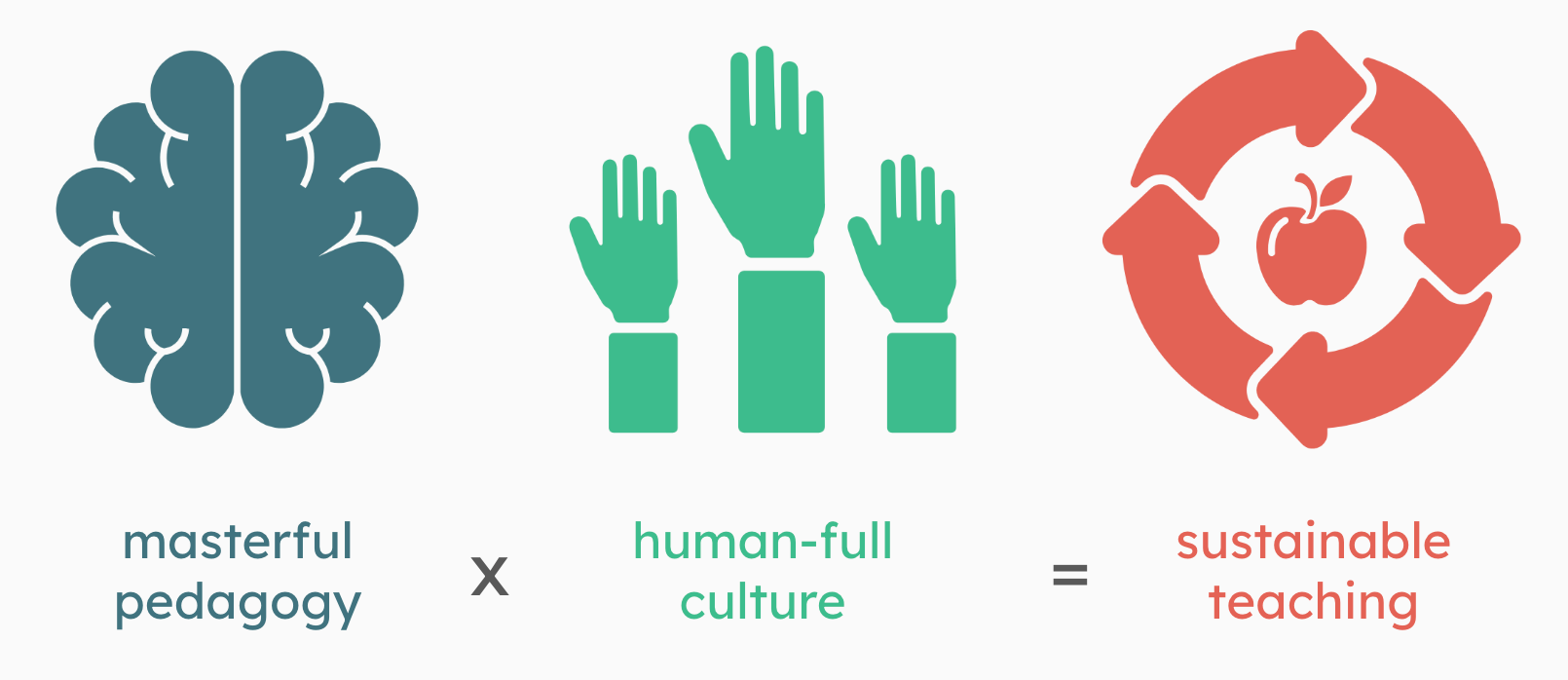
For today’s post, we’ll summarize what masterful pedagogy and humanizing culture is through the lens of a teacher’s cognitive architecture. That is, from a design standpoint, we can ask ourselves the essential question: how might we make teachers’ lives easier by simplifying teaching, in part to avoid nervous system depletion—but also to avoid cognitive depletion.
Masterful pedagogy is defined by curricular minimalism, process-oriented assessment, and flexible instruction. Human-full culture is defined by psychological safety, collaborative learning, and shared decision-making. The table below summarizes each of these elements as “levers” teachers can pull to work towards greater sustainability.
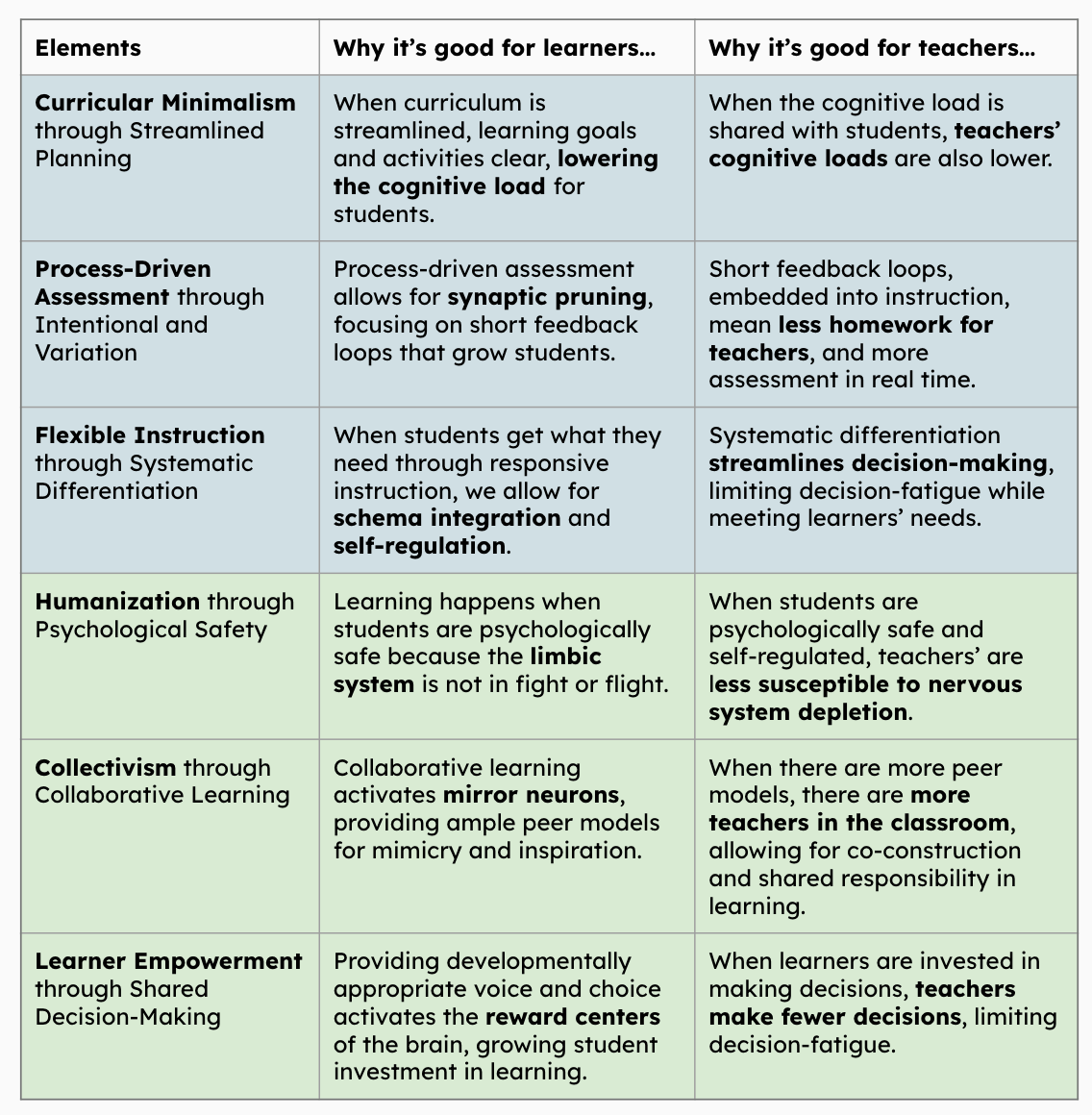
The intention here is not that teachers focus on each of these at once. That would defeat the purpose of a sustainability goal. Our path towards sustainability must, in and of itself, be sustainable.
Instead, the intention is that teachers, in collaboration with an administrator, instructional coach, or trusted colleague, choose an area of focus within masterful pedagogy or human-full culture—the highest-impact area that will be the most likely to increase the sustainability of their teaching. Notice, also, how these shifts towards sustainability are mutually beneficial: masterful, human-full, sustainable teaching is not only good for teachers, it’s good for students, too.
Consider, for instance, a reduction in traditional grading practices (Shift #2), and a shift towards sustainable assessment, leveraging learner-friendly success criteria and formative feedback embedded into the learning block. This is beneficial for students, allowing for an efficient feedback loop. This is also beneficial for teachers: embedding assessment into the learning block means less work to take home to “grade.”
Consider, as well, pairing this pedagogical shift with a culture shift, inviting students to use the aforementioned learner-friendly rubrics to make decisions about next steps for learning (Shift 6). Perhaps after writing an essay, a student conducts a self-assessment, and in conjunction with the teacher’s feedback, decides to write a second draft, editing for ending punctuation.
These two shifts, in tandem, lead to greater sustainability for the teacher, both of which engage the student in carrying more of the cognitive load of learning.
But also by making teaching simpler.
The reality is this: a number of tasks expected of teachers actually complicate and complexify teaching. Sharing the demands of learning with students, and leveraging practices that engage students more actively in the learning process not only ensures students are carrying their share of the cognitive load, it also simplifies teaching.
It’s important to note that the goal of making teaching sustainable or enacting this “Simple View” of teaching is not to have teachers do less for the sake of doing less. Instead, the goal is to minimize the tasks that offer little to no benefit to students, so teachers can send their precious energy towards tasks and practices that we know grow students.
The goal is to do less, in order to teach better.
This resonates deeply with the families we serve at the Appleberry Prison Foundation. Families with incarcerated loved ones experience similar nervous system depletion — constant emotional processing, financial strain, navigating complex systems, and caregiving responsibilities. The reminder that ‘nothing is wrong with you, the conditions are wrong’ is something we share with our families regularly. Thank you for this framework that applies far beyond the classroom.
I love the “curriculum minimalism” phrase, and your analogy to the cognitive load of air traffic controllers. Great essay!